Your Body is Your Primary Rig: Why Paramedic Longevity Demands Smart Training
Summary: Training for the Long Haul in Paramedicine In paramedicine, your body is your most vital piece of equipment, but the field doesn't offer a controlled, ergonomic environment. To survive a decades-long career without a debilitating injury, paramedics must shift their mindset from aesthetic "muscle building" to functional movement training, focusing on the Big Four operational patterns: the hinge, the squat, the loaded carry, and the braced core. By understanding Bona Fide Occupational Requirements (BFORs) as a blueprint for career longevity rather than just a pre-employment hurdle, medics can build a physical reserve that turns maximum-strain tasks into manageable, sub-maximal efforts. Crucially, staying healthy requires managing your "Stress Bucket", understanding that physical workouts, 12-hour night shifts, and high-acuity call stress all drain the same central nervous system. Through smart periodization (planning training intensity around shift fatigue), paramedics can build a resilient chassis, prevent overtraining syndrome, and peak for high-stakes assessments without crashing their systems. scription.
Your Body is Your Primary Rig: Why Paramedic Longevity Demands Smart Training
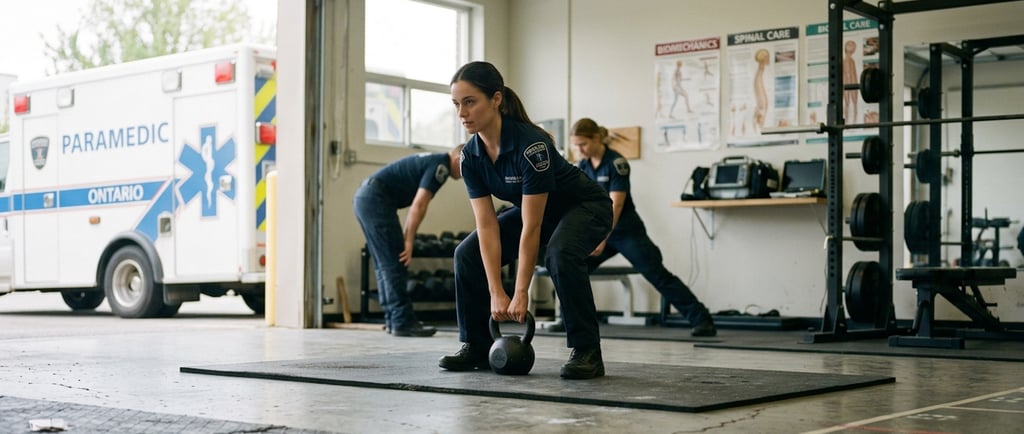
Ask any veteran medic about their most valuable piece of equipment, and they won't tell you it's the monitor, the airway bag, or the power-stretcher. They’ll tell you it’s their spine.
In paramedicine, your body is your primary rig. But unlike a controlled gym environment where the floor is flat, the lighting is good, and the barbell is perfectly balanced, the "field" doesn't care about your ergonomics. The field demands that you lift an asymmetrical, 210-pound load in a cramped bathroom, on wet tile, at three in the morning.
If you are a paramedic student or a rookie on the road, you’ve likely heard a lot about Bona Fide Occupational Requirements (BFORs). But BFORs shouldn't be viewed as just another administrative hoop or a stressful fitness test you need to pass once to get hired. They are a baseline blueprint for survival in a punishing profession.
To survive a 30-year career without a career-ending injury, you have to shift your mindset. You aren't training to look good or run fast; you are training for operational readiness.
Demystifying the BFOR: Your Realistic Job Preview
Think of BFORs as your legal and physical reality check. Paramedicine is a high-stakes, physically demanding job, and learning the "why" behind the physical standards, like the specific muscle groups needed for a heavy stretcher lift, is just as critical as learning your clinical protocols.
Understanding these standards early provides a realistic job preview. It gives you a crystal-clear picture of what your career demands so you can accurately assess your own physical readiness before you ever step foot in an ambulance.
Furthermore, it directly impacts patient safety. If a medic lacks the physical capacity to deliver high-quality chest compressions or safely extricate a patient from a vehicle, patient outcomes plummet. Your physical strength is literally the link between a vulnerable patient and life-saving care.
There is also a vital legal landscape to consider. Understanding BFORs empowers you to know your rights regarding the "Duty to Accommodate" and workplace standards, ensuring you know how the law protects both you and your employer. Ultimately, meeting these standards isn't a one-time event like passing a college exam, it is a career-long professional accountability.
Moving From "Muscle Building" to "Movement Training"
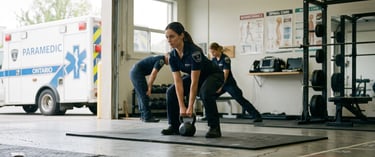
When you hit the gym, it helps to stop thinking about training isolated muscles like biceps or calves. On the road, we don’t use muscles in isolation; we use movement patterns. Based on the actual physical demands of a medic, your training should revolve around the "Big Four" patterns that show up on almost every single call:
The Hinge (The Deadlift): This is your bread and butter. The hinge pattern is essential for the "power lift" from the floor and managing a loaded cot. It targets your posterior chain, your glutes, hamstrings, and lower back. If you don't master the hinge, your lower back will bear the brunt of every lift.
The Squat: Crucial for stair-chair carries, low-angle extractions, and getting down to patient level. A strong squat ensures your legs do the heavy lifting, not your spine.
The Loaded Carry: Think about walking up three flights of stairs carrying a tech bag, a monitor, and an oxygen cylinder. That is a loaded carry. Training this builds total-body stability, grip strength, and upper-back resilience.
The Braced Core: Forget six-pack abs. For a paramedic, core stability means the ability to keep your spine completely rigid while moving an unpredictable, moving load in a tight space. It’s your internal weight belt.
Mitigating Injury and Creating a "Physical Reserve"
Most injuries on the road occur when the demand of the task exceeds the current capacity of your tissue. The big problem areas for medics are entirely predictable: lower backs blown out by rounded-back lifting, shoulders strained during awkward overhead reaching, and knees taking abuse from jumping out of the ambulance or pivoting with a load.
Resistance training with compound movements strengthens your tendons, ligaments, and bone density. This builds what is known as a physical reserve. If your body is strong enough to handle a heavy deadlift in the gym, a 210-pound stretcher lift becomes a sub-maximal effort rather than a maximum-strain event. You stop operating at your absolute physical limit on every call.
As a bonus, high-intensity training conditions your nervous system to handle the "sympathetic surge” that massive spike of adrenaline you get when a high-acuity call drops. If your body knows what it feels like to perform under physical stress in training, your mind can stay stable, calm, and focused when the real-life emergency hits.
Managing the "Stress Bucket" With Periodization
Because the physical demands of paramedicine are cumulative, a single, massive lift rarely ends a career. Instead, it’s the thousands of sub-maximal lifts performed while fatigued, dehydrated, and poorly positioned over a decade or two that lead to chronic breakdown.
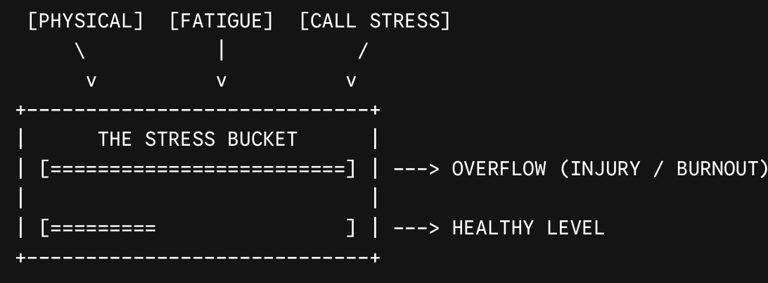
To prevent this, you cannot train at 100% intensity all year round. Doing so runs straight into Overtraining Syndrome, a state of chronic fatigue that, for a medic, means a lack of focus on a scene, a higher risk of a needle-stick injury, or a back strain while lifting a patient. This is why periodization (the systematic variation of your training loads) is essential. It allows you to manage your "Stress Bucket."
Your body doesn't know the difference between physical stress (heavy squats), physiological stress (a 12-hour night shift), or mental stress (academic exams or a traumatic call). It all goes into the same bucket. If you try to crush a high-intensity workout after a brutal night shift on zero sleep, your bucket overflows.
Think of periodization as your operational deployment map. It allows you to map out high-intensity blocks when you are off-shift and recovered, and shift into maintenance or recovery blocks when your work or school demands are peaking. It also lets you strategically time your training so your strength and aerobic recovery peak exactly when you need them to for high-stakes physical assessments like the OPPAT or municipal hiring tests.
The Long Haul
You wouldn't drive an ambulance into a complex scene without a plan; you shouldn't drive your body into high-intensity training without one either. By manipulating your sets, reps, and loads, you ensure that you are always moving toward your goal without crashing your system.
Train like an tactical athlete, treat your body like the primary piece of lifesaving equipment it is, and ensure you can protect your patients without breaking yourself.